Showing posts with label hippopotamus. Show all posts

hippopotamus paya indah wetland

hippopotamus paya indah wetland

hippopotamus paya indah wetland

hippopotamus paya indah wetland


Paya Indah Wetlands is growing on me. When I first visited this park (located about 15 minutes drive south-west of Putrajaya - Cyberjaya) about a year ago I wrote in my blog that it was a bit of an odd place and that more work was needed to turn it into a first class facility.

Having just gone back there (June 2011) I am pleased to report that there has been significant improvement.

View from Lookout Tower, Paya Indah Wetlands

Paya Indah (which means 'beautiful swamp') is a man-made wetlands area created in 1998 on land which had been heavily degraded by tin mining and sand dredging activities.

The excavations left by the mining works have been converted into lakes which are now home to fish, lotus plants and water lilies and some more exotic species, namely crocodiles and hippos.

Paya Indah Wetlands, Lotus lilies on Typha Lake

New trees have been planted which, combined with the surviving earlier forest, are now attracting a wide variety of bird species, insects and animals.

The Department of Wildlife & National Parks has done a good job over the past year in regenerating this eco-tourism park's facilities which had earlier seemed to be unutilised.

They have also recently built a lookout tower providing a 360 degree view of the whole area. It is still very green but I noted that dredging activity is going on just outside the park boundary and that patches of trees have been cleared for agricultural or development purposes near the park.

Lookout Tower, Paya Indah Wetlands

Here is a list of ACTIVITIES which are now available at Paya Indah Wetlands.

Bird Watching

The park is open for bird watching from 7:30am to 7pm. There is no charge (admission to Paya Indah is free) but bring your own binoculars. The types of birds which have been spotted here are:

- purple swamp hen

- white breasted water hen

- olive backed sunbird

- brown shrike

- red wattled lapwing

- Swinhoe's snipe

- yellow vented bulbul

- peacock

Jungle Trekking

The Typha Trail is available for trekking. Much of the woodland in the recreational zone has been recently planted so do not expect the same sort of lush jungle that you encounter in other parks in Malaysia.

Cycling

I was pleased to see on my last visit that bicycles are available again. They look in good condition and can be rented for RM5 for 2 hours. Tricycles are provided for children under 6 years old at RM3 for 2 hours.

This is a spread out (and flat) park so a bicycle is a good way of covering the distances. Take a hat and water though because there are a lot of open exposed spaces.

Hippo Feeding

Paya Indah Wetlands - Hippo

Two hippos, originally from Botswana, live in the Hippo Pond enclosure. The best time to see them is feeding time (10am - 10:30am). They spend much of the rest of the day semi-submerged in the lake to prevent their surprisingly sensitive skin from getting sunburnt.

Crocodile Feeding

Crocodile at Paya Indah Wetlands, Dengkil

After seeing the hippos eat their breakfast you should make your way to the nearby crocodile lake in time for the crocs' feeding session (11am - 11:30am on Saturdays and Sundays only. Don't the poor crocs eat on weekdays?)

The massive fierce-looking crocodiles were apparently transported to Paya Indah from Langkawi which puts me off exploring the wilds of Langkawi a little bit.

Fishing

Fishing is possible on Typha Lake from 8am - 6:30pm everyday except Fridays. The cost is RM10 per rod. No live bait is allowed.

Fishermen tell me that Marble Goby and Giant Snakehead are typical of the type of fish which inhabit this pool.

Kayaking

Kayak rental costs RM7 per hour. An instructor can be hired for groups of between 10 to 20 people at RM180 for 3 hours (prior reservation is needed).

The hours for kayaking are 9am - 12pm, 3pm - 6pm.

FACILITIES

On my first visit to Paya Indah the accommodation was not in use but now it is available for those wishing to stay overnight.

Lobby for Paya Indah Wetlands Chalets

At the smart accommodation reception (above) you can check in for one of the park's 29 Chalets which sleep two people (double bed) and are air conditioned.

And very nice they look too and good value at the very reasonable price of RM120 per night.

Chalet at Paya Indah Wetlands, Selangor

Dormitories and a camp site are also available at RM 9 per person/site/night.

For more information and bookings contact

Paya Indah Wetlands

Jabatan Perhilitan

Km 4, Jalan Dengkil - Banting

43800 Dengkil

Selangor Darul Ehsan

Malaysia

Tel: +603-87687616

Fax: +603-87688424

Email: piw@wildlife.gov.my

HOW TO GET THERE

Paya Indah Wetlands is quite well sign-posted. Coming from Putrajaya head towards Dengkil. At the traffic lights in Dengkil turn right towards Banting. After a couple of kilometres turn right when see a sign for Paya Indah. Follow the road to the end. There is plenty of parking. 

The hippopotamus 2012

blue hippo

hippopotamus

hippopotamus zoo

blue hippo 2012

The hippopotamus (Hippopotamus amphibius), or hippo, from the ancient Greek for "river horse" (ἱπποπόταμος), is a large, mostly herbivorous mammal in sub-Saharan Africa, and one of only two extant species in the family Hippopotamidae (the other is the pygmy hippopotamus). After the elephant and rhinoceros, the hippopotamus is the third largest type of land mammal and the heaviest extant artiodactyl. Despite their physical resemblance to pigs and other terrestrial even-toed ungulates, their closest living relatives are cetaceans (whales, porpoises, etc.) from which they diverged about 55 million years ago. The common ancestor of whales and hippos split from other even-toed ungulates around 60 million years ago. The earliest known hippopotamus fossils, belonging to the genus Kenyapotamus in Africa, date to around 16 million years ago.

The hippopotamus is semi-aquatic, inhabiting rivers, lakes and mangrove swamps, where territorial bulls preside over a stretch of river and groups of 5 to 30 females and young. During the day, they remain cool by staying in the water or mud; reproduction and childbirth both occur in water. They emerge at dusk to graze on grass. While hippopotamuses rest near each other in the water, grazing is a solitary activity and hippos are not territorial on land. Hippos are recognizable by their barrel-shaped torso, enormous mouth and teeth, nearly hairless body, stubby legs and tremendous size. They are the third largest type of land mammal by weight (between 1½ and 3 tonnes): the only heavier species on average are the white and Indian rhinoceroses, typically 1½ to 3½ tonnes, and the elephants, typically weighing 3 to 9 tonnes. The hippopotamus is one of the largest quadrupeds and, despite its stocky shape and short legs, it can easily outrun a human. Hippos have been clocked at 30 km/h (19 mph) over short distances. The hippopotamus is one of the most aggressive creatures in the world and is regarded as one of the most dangerous animals in Africa. Nevertheless, they are still threatened by habitat loss and poaching for their meat and ivory canine teeth.


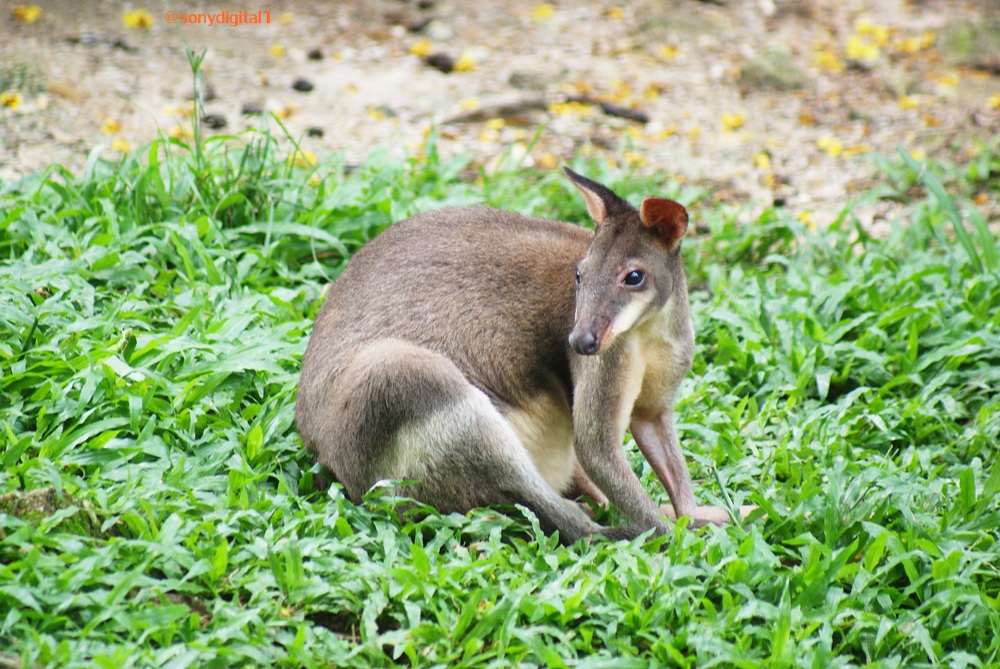
Hippopotamus Vs Small Kangaroo

small kangaroo

kangaroo?

maybe kangaroo

The kangaroo (/ˌkæŋɡəˈruː/) is a marsupial from the family Macropodidae (macropods, meaning 'large foot'). In common use the term is used to describe the largest species from this family, especially those of the genus Macropus, red kangaroo, antilopine kangaroo, eastern grey kangaroo and western grey kangaroo.Kangaroos are endemic to the country of Australia. The smaller macropods are found in Australia and New Guinea.

Kangaroos have large, powerful hind legs, large feet adapted for leaping, a long muscular tail for balance, and a small head. Like most marsupials, female kangaroos have a pouch called a marsupium in which joeys complete postnatal development.
Larger kangaroos have adapted much better[which?] to changes brought to the Australian landscape by humans and though many of their smaller cousins are endangered, they are plentiful. They are not farmed to any extent, but wild kangaroos are shot for meat, leather hides, and to protect grazing land for sheep and cattle. Although there is some controversy, harvesting kangaroo meat has many environmental and health benefits over traditional meats.

The kangaroo is an unofficial symbol of Australia, and appears as an emblem on the Australian coat of arms, on some of its currency, and is used by some of Australia's well known organisations, including Qantas and the Royal Australian Air Force. The kangaroo is important to both Australian culture and the national image, and consequently there are numerous popular culture references.


hippopotemus


The hippopotamus (Hippopotamus amphibius), or hippo, from the ancient Greek for "river horse" (ἱπποπόταμος), is a large, mostly herbivorous mammal in sub-Saharan Africa, and one of only two extant species in the family Hippopotamidae (the other is the pygmy hippopotamus). After the elephant and rhinoceros, the hippopotamus is the third largest type of land mammal and the heaviest extant artiodactyl. Despite their physical resemblance to pigs and other terrestrial even-toed ungulates, their closest living relatives are cetaceans (whales, porpoises, etc.) from which they diverged about 55 million years ago. The common ancestor of whales and hippos split from other even-toed ungulates around 60 million years ago. The earliest known hippopotamus fossils, belonging to the genus Kenyapotamus in Africa, date to around 16 million years ago.

The hippopotamus is semi-aquatic, inhabiting rivers, lakes and mangrove swamps, where territorial bulls preside over a stretch of river and groups of 5 to 30 females and young. During the day, they remain cool by staying in the water or mud; reproduction and childbirth both occur in water. They emerge at dusk to graze on grass. While hippopotamuses rest near each other in the water, grazing is a solitary activity and hippos are not territorial on land. Hippos are recognizable by their barrel-shaped torso, enormous mouth and teeth, nearly hairless body, stubby legs and tremendous size. They are the third largest type of land mammal by weight (between 1½ and 3 tonnes): the only heavier species on average are the white and Indian rhinoceroses, typically 1½ to 3½ tonnes, and the elephants, typically weighing 3 to 9 tonnes. The hippopotamus is one of the largest quadrupeds and, despite its stocky shape and short legs, it can easily outrun a human. Hippos have been clocked at 30 km/h (19 mph) over short distances. The hippopotamus is one of the most aggressive creatures in the world and is regarded as one of the most dangerous animals in Africa. Nevertheless, they are still threatened by habitat loss and poaching for their meat and ivory canine teeth.


LinkWithin

Related Posts Plugin for WordPress, Blogger...